
Cell and gene therapies are no longer speculative science. They’re commercial reality. The FDA has approved dozens of CAR-T therapies, viral vectors, and allogeneic cell products over the past five years. But for every approved therapy on the market, there are 20 in development struggling with the same problem: manufacturing at clinical scale within a regulatory framework that didn’t exist ten years ago.
The challenge isn’t the biology. Most development teams have solid process understanding by the time they reach IND stage. The challenge is building a facility and manufacturing system that satisfies FDA’s expectations for a product category where the rules are still being written in real time.
We’ve worked on mammalian cell culture facilities, viral vector systems, and autologous cell processing plants. The patterns repeat. And the cost of getting them wrong isn’t academic—it’s 18-24 months of delay and $5M-$15M in unplanned capex or operational restructuring.
Why Cell & Gene Therapy Is Different
Traditional pharma manufacturing—insulin, mAbs, recombinant proteins—operates on established regulatory templates. FDA published ICH guidelines. We know what “adequate” looks like. Process consistency is validated through DOE and control strategy.
Cell and gene therapy doesn’t have that luxury.
The Process Is Inherently Variable
You’re culturing living cells or manufacturing viral vectors in media that varies batch-to-batch. Each cell line has unique passage characteristics. Upstream process parameters that barely matter in bacterial fermentation become critical: oxygen perfusion rates, shear stress, osmolality, pH oscillation, media composition. Small changes compound through bioprocess amplification.
One facility we worked with thought they had a locked process. Phase II happened. They changed suppliers for one amino acid in their culture medium. Same concentration, different manufacturer. Cell viability dropped 8%. They spent six months troubleshooting because they hadn’t mapped how sensitive their process was to feedstock variability.
Scalability Isn’t Linear
You developed your process in 5L single-use bioreactors. Clinical manufacturing will be 50-200L. Commercial scale might be 500L or larger. Each scale jump introduces physical changes: dissolved oxygen gradients, mixing inefficiency, temperature variation, shear forces on fragile cells.
We’ve seen successful 5L processes fail at 50L because oxygen transfer became limiting. We’ve seen viable cell populations crash at scale because shear stress from larger impellers damaged cells. These aren’t failures of your scientists. They’re physics problems that only appear at scale.
Product Characterization Is Moving Target
Traditional pharmaceuticals: you measure potency, purity, and identity through well-established assays. Cell therapies: your product is a living population with phenotypic heterogeneity. How do you measure a CAR-T population? Do you count cells? Do you measure activation markers? Do you run functional assays? What’s your acceptance range?
FDA guidance on cell therapy potency (published 2018, updated 2022) explicitly acknowledges that product definition is sponsor-specific. You’re not following a recipe. You’re building the recipe while FDA watches and adjusts expectations.
The Regulatory Reality
FDA’s approach to cell and gene therapy is fundamentally different from traditional small molecule or biologic manufacturing. Here’s what regulators actually require:
CMC Strategy Must Be Defined Early
CMC = Chemistry, Manufacturing, and Controls. For traditional pharma, this is secondary to safety/efficacy data. For cell therapy, it’s co-equal.
Your IND application needs a credible CMC narrative before Phase I even starts. That means:
- Process characterization strategy – How will you identify critical process parameters? What’s your DOE plan?
- Product characterization plan – What attributes define your product? How will you measure them?
- Manufacturing facility plan – Where will you manufacture? What’s your quality system?
- Analytical method validation plan – Every assay must be validated to ICH Q14 or equivalent
- Scale-up plan – How will you move from clinical to commercial scale?
Most development teams arrive at this conversation too late. They’re already at Phase II before someone asks, “What’s our commercial manufacturing strategy?” By then, reworking your facility adds 12-18 months and $8M+ to your timeline.
Your Facility Must Be Designed for Data Integrity
21 CFR Part 11 compliance for electronic records is strict. But cell therapy adds layers: environmental monitoring, cell population tracking, automated data collection, batch genealogy.
Your DCS (Distributed Control System) must capture every bioreactor parameter in real time. Your ERP (Enterprise Resource Planning) must track every input material lot. Your LIMS (Laboratory Information Management System) must link cell population data to production outcomes. If a batch fails, you must reconstruct exactly what happened—which donor, which media lot, which environmental condition—to determine if it was product-specific or process-wide.
Most facilities we’ve worked on underestimate this work. They budget $500K for IT infrastructure. The actual cost is $2M-$3M when you include validation, cybersecurity, disaster recovery, and change management systems.
Donor/Source Material Control Is Non-Negotiable
For autologous therapies, your patient is your raw material. For allogeneic cells, you’re selecting from a donor population. For viral vectors, you’re selecting a master cell bank.
FDA expects documented characterization of every source:
- For patient-derived cells: Disease status, comorbidities, prior treatments, genetic markers, baseline cell viability/phenotype
- For allogeneic cells: Population characterization, passage history, potency testing on every lot
- For viral vectors: Master cell bank qualification, working cell bank testing, viral titer/purity validation
This isn’t just regulatory box-checking. Bad source material propagates through your entire batch. One facility manufactured allogeneic CAR-T cells from a donor population with undetected chronic viral infection. Ninety percent of their manufacturing run had to be discarded. They lost a year rebuilding donor screening protocols.
Environmental Monitoring Must Be Aggressive
Unlike bacterial fermentation (which kills contamination), cell therapy processing often can’t tolerate sterilization in place (SIP). You’re running in non-sterile or semi-sterile environments. That means:
- Continuous environmental monitoring – Particle counters, viable particle samplers, gaseous phase monitoring
- Micro-environmental control – Class B/C clean rooms for fill-finish, Class A isolators where appropriate
- Contamination investigation protocols – If you detect microbial growth, you must investigate root cause and document remediation
We’ve seen facilities that were ISO Class 8 (clean room standard for non-critical areas) try to run aseptic cell processing. FDA rejected their CMC at BLA stage because environmental data showed contamination risk. They had to retrofit $3M in HVAC infrastructure and re-validate their entire process.
Scale-Up: From Clinical to Commercial
Scaling cell therapy isn’t engineering scaling. It’s biological scaling with strict regulatory constraints.
You Must Establish Comparability Across Scales
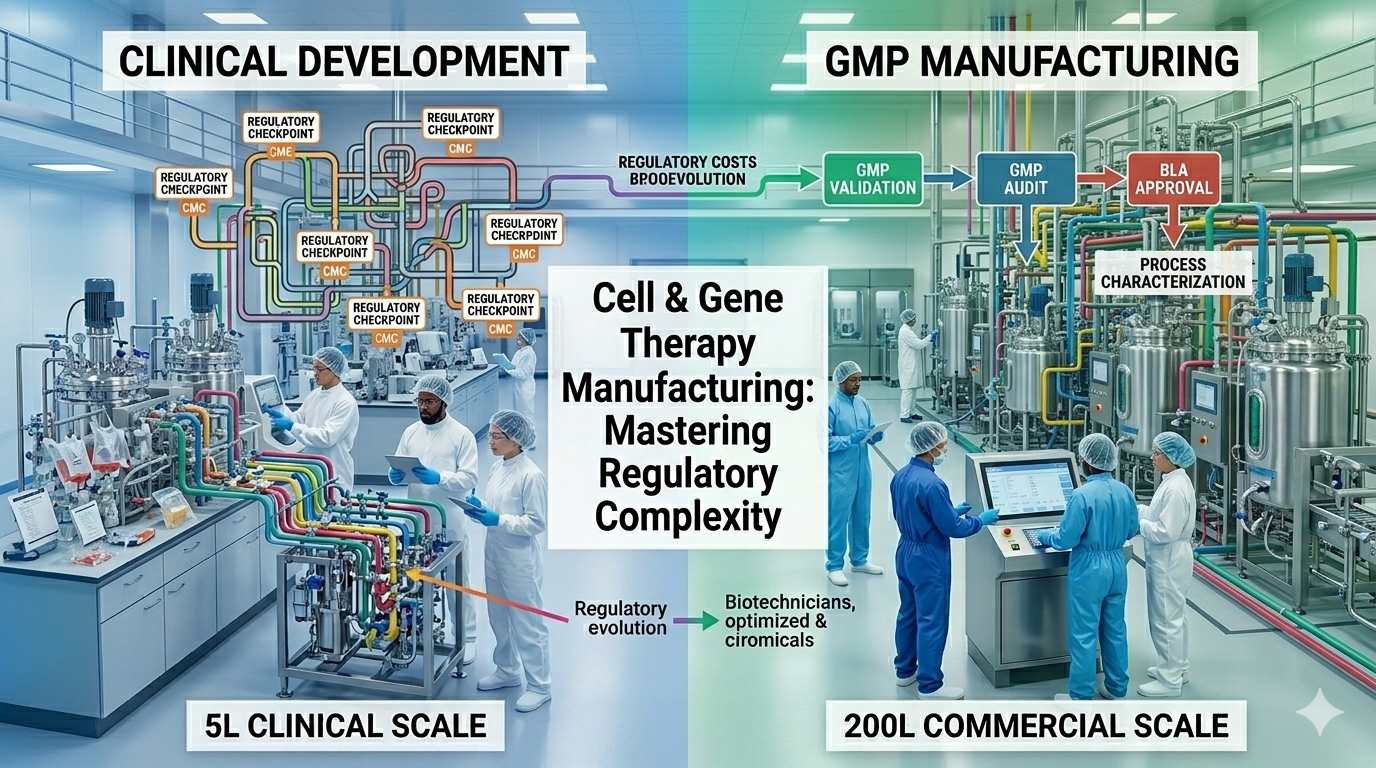
FDA expects you to demonstrate that your 5L clinical-scale process produces the same product as your 200L commercial-scale process. That’s not intuitive. Cells care about oxygen, mixing, temperature uniformity, osmolality—all of which are different at different scales.
Your scale-up strategy needs:
- Mechanistic process understanding – Why does each parameter matter? How does it affect cell phenotype?
- Staged scale-up with data – 5L → 20L → 50L → 200L, with characterization at each step
- Comparability studies – Parallel batches at clinical and commercial scale with functional assays
- Process robustness testing – What happens when oxygen is 5% low? When temperature drifts ±1°C?
Most development teams do one scale-up run and call it done. FDA doesn’t accept that. You need minimum 3-5 scale-up batches with tight parameter control to establish comparability.
Viral Vector Manufacturing Has Unique Constraints
If you’re developing adeno-associated viruses (AAV), lentiviruses, or other viral vectors, your facility has additional requirements:
- Adventitious agent testing – Every lot must be tested for unexpected viruses or bacteria
- Viral removal validation – If you use downstream purification, you must validate that your process removes virus
- Environmental containment – Biosafety considerations for your specific vector
- Potency and purity assays – Viral titer, genome titer, empty particle percentage
Viral vector manufacturing often requires BSL-2 facilities. Not every CDMO can accommodate that. We’ve seen companies discover at manufacturing readiness stage that their chosen facility wasn’t BSL-2 certified and needed 6-12 months of retrofit work.
The Timeline Reality
Here’s what most development teams underestimate: you can’t compress cell therapy manufacturing timelines the way you can compress small molecule chemistry.
Facility Build-Out Takes 18-36 Months
You need:
- Design phase: 4-6 months (facility requirements, clean room design, utility planning)
- Construction: 6-12 months (build, install equipment, utility hookup)
- Qualification: 6-12 months (IQ/OQ/PQ for equipment, environmental monitoring, controls validation)
- Process validation: 6-12 months (three validation batches, regulatory review, approved release)
If you’re using a CDMO with existing facilities, you shave off construction time but add complexity in technology transfer and regulatory alignment. Most CDMO engagements still take 12-18 months from contract to first GMP batch.
Process Stability Requires 18-24 Months of Data
FDA doesn’t just want your process. They want stability data. Your manufacturing process must be consistent across 10-20 batches with documented characterization. That’s real time—you can’t compress it.
We worked with VBL Therapeutics on their Modiin facility—a mammalian cell culture platform for anticancer therapeutics. Their process development showed promise in Phase I. But when they scaled up and started manufacturing qualification batches, they discovered their potency assay was too variable. They spent 18 months refining the assay. Their timeline became 5 years instead of 3.
Cost Implications
People often ask: “How much does it cost to build a cell therapy manufacturing facility?”
The honest answer: $20M-$60M depending on modality.
Minimum facility (allogeneic or autologous cell therapy):
- Build-out: $8M-$15M
- Equipment: $5M-$10M
- Qualification/Validation: $3M-$5M
- IT/Data integrity systems: $2M-$3M
- First three validation batches: $2M-$4M
- Total: $20M-$37M
Viral vector facility (additional requirements for containment/testing):
- Same as above, plus:
- BSL-2 certification/upgrades: $2M-$5M
- Potency/titer assay development: $1M-$2M
- Total: $25M-$45M
De novo facility (building from scratch): Add $10M-$20M for land, construction, permitting.
Most companies don’t have this budget for a Phase I product. That’s why so many cell therapy companies use CDMOs. But CDMO costs run $50K-$200K per batch in manufacturing fees, plus technology transfer and qualification.
The Decision Framework
If you’re developing a cell or gene therapy, here’s how to think about manufacturing:
Can You Use an Existing CDMO?
Yes, if:
- Your process fits their platform (they have compatible cell lines, viral vectors, or equipment)
- Their quality system and facility already meet your regulatory path
- Your scaling needs fit their equipment (some CDMOs max out at 50L)
- You can tolerate batch costs of $75K-$150K
No, if:
- Your process is proprietary (you need cell line secrecy)
- Your manufacturing timeline is aggressive (you need dedicated capacity)
- Your scaling needs exceed their equipment range
- You’re manufacturing >20 batches annually (CDMO becomes expensive)
Should You Build Your Own Facility?
Yes, if:
- You have commercial-scale volume (>30 batches/year) projected within 5 years
- You have capital ($20M+) and can absorb pre-revenue facility costs
- Your manufacturing process is proprietary and requires confidentiality
- You can plan 18-24 months ahead (it takes that long to build)
No, if:
- You’re pre-clinical or early IND (too much uncertainty)
- You have limited capital
- Your process might change significantly during clinical development
Hybrid Approach
Many companies use CDMO for Phase I/II, then build in-house for Phase III/commercial. This balances:
- Capital efficiency: You don’t build until you have validated process and regulatory pathway
- Schedule control: You own manufacturing for critical regulatory phases
- Cost optimization: You reduce per-batch CDMO costs once manufacturing is locked
This requires planning. Your facility design must be ready 18 months before you need it. If you wait until BLA filing to start facility planning, you’ll miss your launch window.
The Bottom Line
Cell and gene therapy manufacturing isn’t just biopharmaceutical manufacturing with different biology. It’s a different regulatory paradigm where manufacturing strategy is co-equal to clinical strategy.
The teams that succeed are those that engage manufacturing and regulatory expertise early—during process development, not after clinical proof-of-concept. They map their CMC pathway. They understand their facility constraints. They validate their analytical methods in real time, not in retrospect.
The cost of getting this wrong isn’t academic. It’s 18-24 months of delay and $5M-$15M in unplanned capex or operational restructuring.
If you’re developing a cell therapy, the decision about manufacturing strategy should happen now, not when you’re preparing your BLA.