
When you walk into most biopharmaceutical facilities built before 2010, you see the same thing: rows of stainless steel bioreactors. They’re expensive, validated, and require constant cleaning-in-place protocols. They’re also the industry standard.
But something changed over the past 15 years.
Single-use bioreactors—disposable systems with integrated sensors and pre-sterilized bags—went from fringe technology used only for media prep to serious contenders for primary production. Today, 60-70% of new biotech facilities under construction are designing around single-use, not steel. This isn’t hype. It’s a fundamental shift in how we build manufacturing infrastructure.
The question for established pharma manufacturers isn’t whether single-use is viable anymore. It is. The question is: when does it make economic sense for your operation?
The Financial Reality
Let’s start with the numbers, because everything else flows from here.
A stainless steel bioreactor—let’s say 200L—costs $400K-$600K capital. Then you add:
- CIP/SIP infrastructure: $200K-$400K
- Installation and validation: $150K-$250K
- Utility connections (steam, water, nitrogen lines): $100K-$200K
- Total installed cost: roughly $850K-$1.45M
Maintenance runs $50K-$80K annually. Cleaning validation (every 2-3 years): $30K-$50K. Capital replacement every 10-15 years.
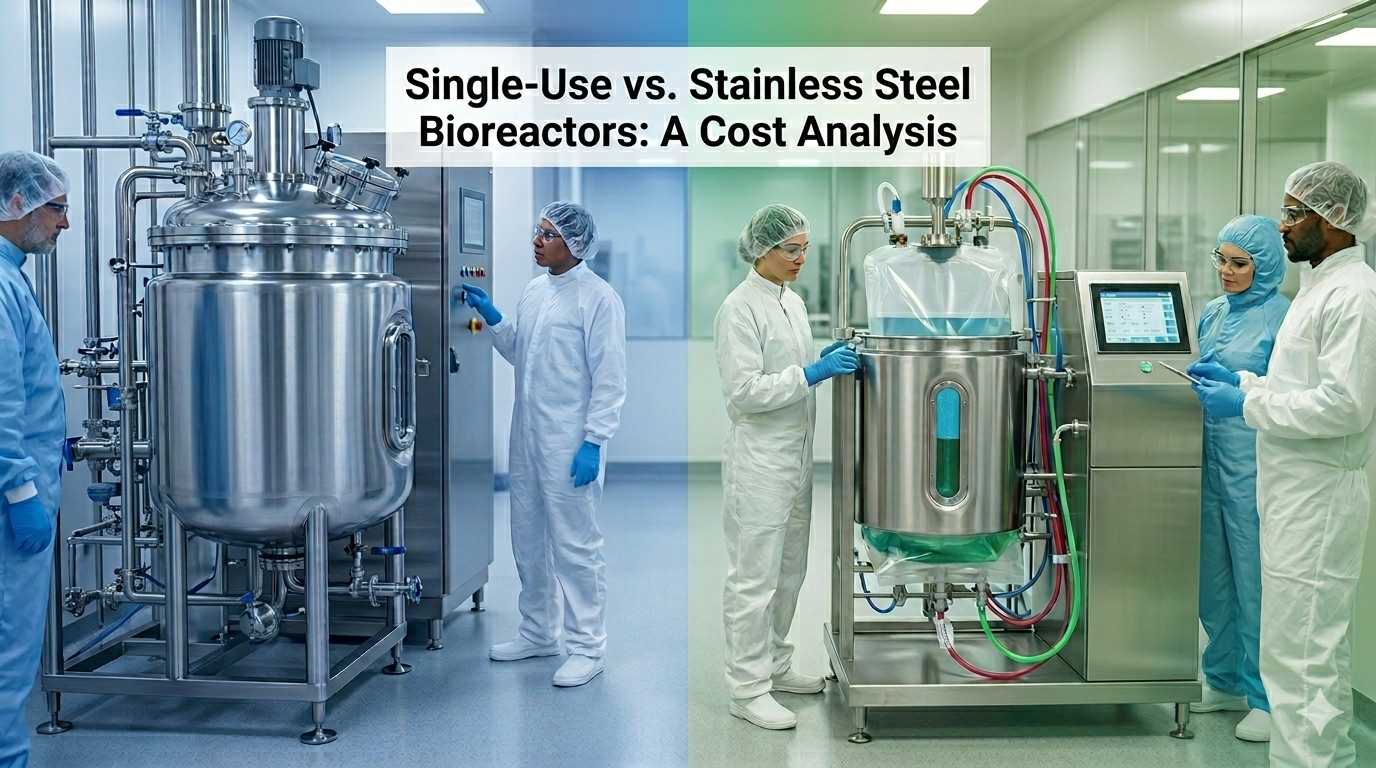
A single-use bioreactor system—same 200L capacity—costs $150K-$250K in equipment. Pre-sterilized bags run $2K-$4K each. The advantage: zero CIP/SIP infrastructure required. Installation is straightforward—plug it in, run it, discard.
10-Year Cost Comparison
Stainless Steel:
- Capital: $1.2M (average)
- Annual maintenance: $65K × 10 = $650K
- Cleaning validation: $40K × 3 cycles = $120K
- Utilities (incremental): $30K annually × 10 = $300K
- Total 10-year cost: ~$2.27M
Single-Use:
- Capital: $200K (average)
- Bags/consumables: $3K × 80 batches = $240K
- Equipment service/support: $20K × 10 = $200K
- Utilities (minimal): $5K annually × 10 = $50K
- Total 10-year cost: ~$690K
That’s a $1.58M difference. Even accounting for higher consumable costs and more frequent equipment replacement cycles, single-use wins on pure economics for most scenarios.
But here’s the catch: that calculation only works if you have utilization discipline. Running 8-10 batches annually matters. If you’re running 3-4 batches, or if your product requires frequent campaign changeovers, the ROI shifts.
When Single-Use Doesn’t Make Sense
Not every facility should convert.
You Have Established, Stable Production With High Utilization
If your facility is running 15+ batches annually on stainless steel with validated processes, the incremental cost of single-use doesn’t justify capital redeployment. Your stainless infrastructure is already depreciated or nearly so.
Your Product Requires Extended Bioreactor Residence Time
Some biologics—certain mAbs, fusion proteins—benefit from extended culture periods in optimized environments. Stainless steel bioreactors have superior dissolved oxygen control, temperature uniformity, and long-term sensor stability. Single-use systems, while improving, still show sensor drift beyond 25-30 day runs.
You Manufacture Multiple Products With Frequent Cleaning Validations
The advantage of single-use (no cleaning) evaporates if regulatory requires cleaning validation between product changeovers for other equipment. You’re paying the regulatory cost without getting the single-use benefit.
Your Facility Is Capital-Constrained
If you can’t afford $200K for single-use equipment, you certainly can’t afford it. But if you’re choosing between stainless and single-use based purely on cash flow, consider debt financing stainless instead. Over 10 years at 5% interest, stainless capital is roughly $140K annually. Single-use consumables are $24K annually. The math depends heavily on your discount rate and opportunity cost.
When Single-Use Wins—And It’s Compelling
Conversely, single-use is genuinely superior if:
You’re Scaling Multiple Products in a Limited Footprint
This is where single-use shines. Different products, different cultivation strategies, different bioreactor requirements. With stainless, you validate once per campaign, then run. With single-use, you plug in, run, discard. At a 5-product facility running quarterly campaigns, this operational simplicity saves $150K-$300K annually in validation costs alone. We’ve seen this approach implemented in the VBL Therapeutics facility in Modiin, where mammalian cell culture processes required flexibility across multiple cultivation strategies and cell lines without extensive cross-product validation overhead.
You’re Developing and Validating New Processes Rapidly
Biotech startups, contract manufacturers (CDMOs), and phase II/III contract manufacturers benefit enormously. You run 3-4 pilot batches, optimize parameters, then scale. With stainless, each batch requires CIP validation. With single-use, each batch is independent.
A customer once told us: “Our validation timeline was 18 months with stainless. With single-use, it was 6 months.” The cost advantage isn’t purely financial—it’s speed to clinic.
You’re Adding Capacity Without Expanding Your Facility
Stainless requires utility upgrades (steam, water, compressed air). Single-use requires outlets. If your facility’s utility infrastructure is already at capacity, single-use lets you add a production line with minimal capex.
We worked with an insulin manufacturer who needed to add 30% capacity without expanding their utility generation. Single-use enabled that expansion for $800K. Stainless would have required $2M+ in new utility infrastructure. Similar capacity constraints drove strategic decisions in our work on the HTBT China insulin production facility, where phased expansion required flexible equipment choices to avoid costly utility redesigns.
Your Product Is Sensitive to Trace Metal Leaching
This is rare but real. Some mAbs, some enzymes, some recombinant proteins are sensitive to metal ions or silicone-based extractables. Stainless steel bioreactors contain chromium, nickel, and molybdenum in their alloys. Single-use systems are plastic.
If your product profile requires ultra-low iron or nickel levels, single-use eliminates an entire class of validation work.
You’re Manufacturing in Markets With Strict Waste Disposal Regulations
This matters less in the US, but in Europe and parts of Asia, large stainless bioreactors require special decommissioning and recycling protocols. Single-use bags are incinerated. If your facility is in an area with high disposal costs or strict environmental oversight, single-use has a hidden advantage.
The Regulatory Reality Check
Here’s what regulators actually care about—and where single-use creates friction:
FDA doesn’t care whether your bioreactor is stainless or single-use. They care about:
- Process consistency (batch-to-batch variability)
- Product safety (contaminants, extractables, adventitious agents)
- Data integrity (sensor data, batch records, control systems)
- Validation rigor (IQ/OQ/PQ, process performance qualification)
Single-use systems can struggle with the first three if not implemented carefully.
Process Consistency Issues
Single-use bioreactors introduce variability that stainless doesn’t. Each bag is a new piece of equipment with slight variations in sensor calibration, bag geometry, and dissolved oxygen delivery. Most manufacturers don’t report this, but we’ve seen batch-to-batch variability increase 15-25% when switching from stainless to single-use for the first time.
That requires either tighter process controls (and more frequent batches to validate robustness) or acceptance of higher lot-to-lot variability.
Product Safety and Extractables
Extractables from single-use bags—plasticizers, antioxidants, processing aids—are real. Most modern single-use systems use film made from thermoplastic polyurethane (TPU) or ethylene vinyl acetate (EVA). These have documented extractable profiles.
If your product captures or absorbs these compounds, you need extractables testing and a risk assessment. This isn’t a blocker, but it requires work.
Data Integrity and 21 CFR Part 11 Compliance
Single-use bioreactors use wireless sensors, digital recording systems, and cloud-based data management. That’s convenient, but 21 CFR Part 11 compliance is stricter for digital than paper. Your DCS/SCADA must be validated, your electronic records must be tamper-proof and time-stamped, and your disaster recovery procedures must be documented.
Stainless steel with a validated analog control system and paper batch records is often easier to audit, even though it sounds outdated.
This doesn’t mean single-use is risky. It means you need different rigor. Most regulatory delays we’ve seen with single-use aren’t because of the bioreactor itself—they’re because manufacturers underestimated the validation and controls work.
The Cell Therapy Wildcard
Cell and gene therapy manufacturing is where single-use becomes almost essential.
Why? Because these processes are inherently variable and small-scale. You’re culturing patient-derived cells or viral vectors in complex media. Each lot is different. Stainless steel infrastructure doesn’t make sense—the validation overhead crushes your timeline and cost.
We’ve worked on mammalian cell culture facilities where single-use was the only rational choice. A 5L stainless bioreactor for clinical manufacturing? That’s validation hell. A single-use 5L bag? Plug it in, run it, dispose of it. Your cost per batch is lower, your time to clinic is faster, and your regulatory scrutiny is actually lighter because FDA understands the constraints of cell therapy.
For established pharma making insulin, monoclonal antibodies, or recombinant proteins at scale? Single-use is a choice, not a necessity. For cell therapy? It’s the default.
The Inflection Point
We’re at an inflection point because:
Single-Use Technology Is Now Mature
Sensor accuracy, bag durability, and system reliability are no longer questions. They work.
Cost Parity Is Approaching
A decade ago, single-use was 30-40% more expensive. Today, it’s often cheaper over 10 years when you account for full lifecycle costs.
Regulatory Acceptance Is Established
FDA has cleared hundreds of commercial products made in single-use systems. There’s no regulatory risk premium anymore.
The Workforce Knows How to Use It
You don’t need specialists. Any manufacturing technician can operate a single-use system.
But—and this is important—the inflection point doesn’t mean stainless steel is obsolete. It means single-use is viable for most scenarios, and for new facilities or significant capacity additions, single-use is now the default starting point unless you have compelling reasons otherwise.
The Decision Matrix
Choose Stainless Steel If:
- High utilization (>12 batches/year) with stable products
- Extended culture periods (>25 days)
- Established processes already validated
- High product sensitivity to extractables
- Capital available, utilization high enough to justify it
Choose Single-Use If:
- Multiple products or rapid process development
- Capacity addition without utility expansion
- Lower utilization (<10 batches/year)
- Cell therapy or novel modality manufacturing
- Speed to clinic is more valuable than marginal cost savings
Hybrid Approach If:
- Mix of stable (stainless) and exploratory (single-use) manufacturing
- Phased scale-up with stainless only after process is locked
This isn’t a procurement decision anymore. It’s a strategic operations decision that should be made alongside your CMC strategy, not after it.
The Bottom Line
Single-use bioreactors aren’t the future. They’re the present. Whether they’re right for your facility depends on your utilization, your product portfolio, and your strategic objectives.
If you’re adding capacity, validate the economic case on a 10-year lifecycle. If you’re developing cell therapy, single-use is probably mandatory. If you have established, high-utilization manufacturing, keep your stainless steel.
The inflection point is simply this: single-use is no longer the expensive, risky alternative. It’s a legitimate choice with genuine tradeoffs.
Evaluate it based on economics and operations. The regulations will follow.